García de Medrano y Álvarez de los Ríos, Lord of San Gregorio (Valladolid, 20 July 1604 – 3 September 1683) was a prominent Spanish nobleman, statesman and jurist from the House of Medrano, holding numerous high-ranking positions throughout his career. He served as regent and interim viceroy of the Kingdom of Navarre, Fiscal (prosecutor), mayor and regent of Seville, and professor at the University of Salamanca. He was also a Knight of the Order of Santiago, perpetual regidor of Soria and procurator in the Cortes, crime prosecutor of the Royal Audiencia and Chancery of Valladolid, auditor of Valladolid, auditor of the Council of Finance and the Council of the Indies, Minister of Finance, Minister of the Council of the Indies, President of the Chamber of Magistrates in Seville, Prosecutor and Councilor of the Royal Council of Castile, Minister of Justice, Minister of Castile and His Majesty's Chamber, and Councilor of the Spanish Inquisition.
In 1657 he presided over the Hall of Mayors of Castile and later reformed the University of Alcalà and the College of San Eugenio. He served as Councilor of the Royal Council of Castile until his death in 1683.
Background
García de Medrano y Alvarez de los Rios, Lord of San Gregorio, was born in Valladolid on 20 July 1604. He was the son of García de Medrano y Castejón, a Knight of Santiago and a member of the Royal Council of Castile, who was married to María Álvarez de los Ríos. This marriage became the foundation of one of the most prominent families of royal legal officials (togados) serving the Spanish Monarchy throughout the 17th and 18th centuries.
The Medrano family, known for their extensive landholdings and wealth, played a key role in managing Soria’s municipal affairs during the 15th century, building their wealth through corn cultivation and sheep farming. By the 16th century, they had risen to prominent positions in central administration, with members serving on the Royal Council of Castile. According to genealogical proofs provided by García de Medrano y Castejón, this branch of the family not only owned the entailed estate and fortress of San Gregorio but also possessed 15,000 sheep.
Progenitor of the Counts of Torrubia
García's son, García de Medrano y Mendizábal, was granted the title of 1st Count of Torrubia, a Spanish noble title created on 29 August 1694 by King Charles II of Spain. His second son, Andrés de Medrano y Mendizábal, succeeded him as the 2nd Count of Torrubia after his elder brother died without heirs.
Castle of San Gregorio
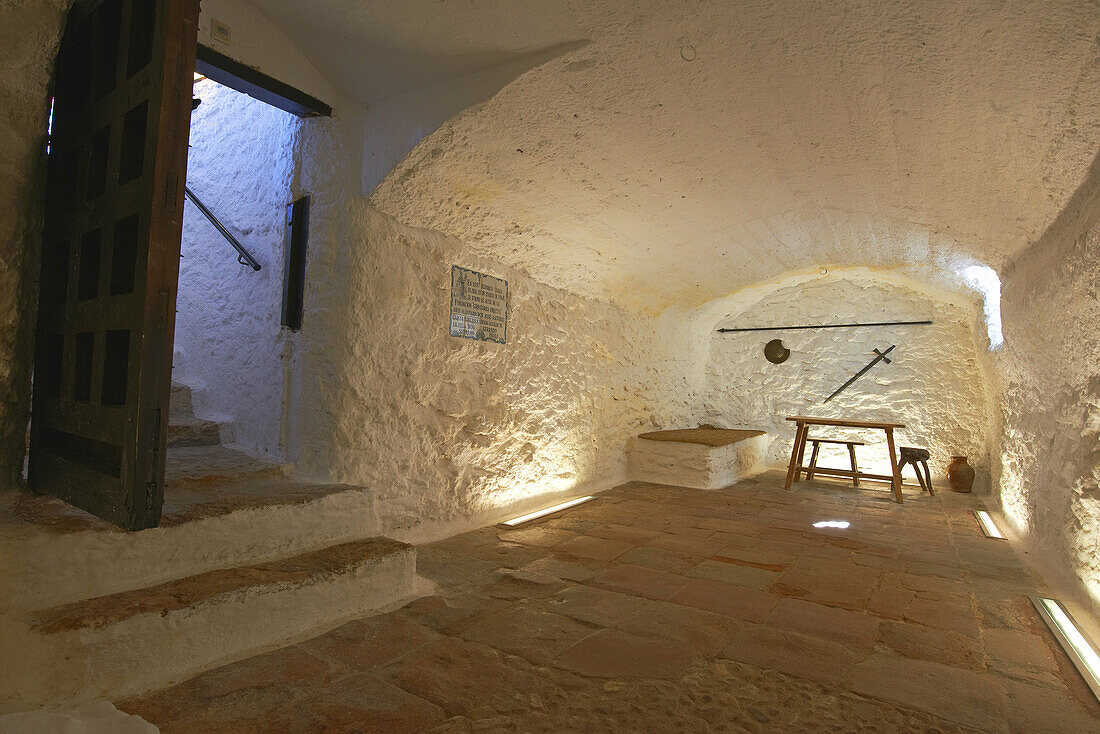
Their ancestral estate is situated in San Gregorio, approximately seven kilometers from La Rubia in the province of Soria. In 1677, García de Medrano added a new construction or renovation to the Castle of San Gregorio, commemorated in stone above the entrance.
House of Álvarez de los Ríos
His mother María Álvarez de los Ríos, from the noble House of Álvarez de los Ríos, was born in Soria and baptized in the parish of Santa María Magdalena on 27 September 1561.
Ancestry
García de Medrano y Álvarez de los Ríos is the paternal grandson of García de Medrano y Vinuesa, born in Soria, and his wife Catalina de Castejon. His grandfather was lord of San Gregorio.
Garcia de Medrano is the paternal great–grandson of Diego López de Medrano, Lord of San Gregorio, and Francisca de Vinuesa, who were known for being immensely wealthy.
Garcia de Medrano is the great–great–grandson of Diego López de Medrano y Vergara, Lord of San Gregorio, a member of His Majesty's Council, and Magdalena Bravo de Lagunas, well-known for their nobility in the Kingdom of Castile.
Relatives
García de Medrano is also the great-uncle of Francisco Antonio de Agurto Salcedo Medrano Zúñiga, Captain General and Governor of the Habsburg Netherlands.
Education
On 18 October 1626, García de Medrano y Álvarez de los Ríos entered the Colegio Mayor de San Bartolomé (Salamanca), graduating in Canons. According to Ruiz y Vergara:
He graduated as a Licentiate in Canons at the College in 1636. On October 17, the Council gave him the position of Sixth Chair of Property, above all the other professors who had been promoted before him.
Career
In the year 1630, he was a judge of studies, and two years later, he was appointed to hold the mayorship and prosecutorship of the Audiencia of Seville until 1636. García served as the perpetual regidor of Soria (or the perpetual legal representative of the king in the municipality of Soria), and procurator in the Cortes.
Professor at the University of Salamanca
His academic career led him to occupy the Chair of Canons on 17 October 1636, and that of Sextus (Sextus Decretalium) and Clementines (Clementine Constitutions) at the University of Salamanca, as professor. He was Doctor of Canons on September 4, 1638.
Prosecutor and auditor of Valladolid
In 1641, Philip IV of Spain appointed him prosecutor of the Chancery of Valladolid and on February 10, 1643, auditor of Valladolid.
Regent of Navarre (1645–1648)
García de Medrano was elected regent of the Kingdom of Navarre on 17 January 1645 following the death of Gabriel Vigil. He remained in this position until 1648.
Interim Viceroy and consultatant to the Viceroy during the Cortes
In November 1645, he presided over the interim viceroy position in Navarre in the absence of the Count of Oropesa. He later served as a consultant to the viceroy during the Cortes of 1645 and 1646.
Despite his brief time in Navarre, he made a strong impact, leading the kingdom to request in 1648 that his replacement be of equal standing, describing him as:
a distinguished figure in governance and letters, worthy as is Don García.
Judge of the Council and General Accounting Office of the Treasury
On April 2, 1648, he was elevated to the position of judge of the Council and the General Accounting Office of the Treasury, though he did not officially assume the role until January 27 of the following year.
Prosecutor of the Royal Council of Castile
He was also appointed prosecutor of the Council of Castile on September 11, 1652.
Regent of Seville, Councilor of Castile
Shortly after, on September 25, 1652, he was elected regent of the Audiencia of Seville and therefore, Councilor of Castile.
President of the Chamber of Magistrates in Seville
In 1657, he presided over the Chamber of Magistrates in the Audiencia of Seville as President.
Hall of Mayors of Castile and educational reforms
In 1657, García de Medrano presided over the Hall of Mayors of Castile and was appointed by the king of Spain as a visitor and reformer to the University of Alcalá and the College of San Eugenio.
Councilor of the Spanish Inquisition
Garcia de Medrano was appointed Councilor of the Supreme Council and General Inquisition on 10 September 1664, he replaced García de Porres, a position he swore on 23 December 1664.
Councilor of the Royal Chamber of Castile
On March 26, 1670, he was elected a member of the Royal Chamber of Castile. Retired in June 1678, he was reinstated in his office on January 1, 1680.
Death
Although King Charles II was reluctant to grant retirements to members of the Council of Castile, García de Medrano was authorized to retire in 1678 due to his advanced age and the fact that he attended council meetings only 15 to 20 days a year. Shortly thereafter, he was officially granted retirement, but by January 1680, he returned to his duties, serving until his death on 3 September 1683.
Ecclesiaatical patronage
At the time of his passing, García de Medrano y Álvarez de los Ríos had under his patronage several religious institutions in Spain.
Burgos
In Burgos, Medrano patronized the Convent of Las Huelgas, a royal Cistercian monastery founded in 1187 by King Alfonso VIII and Queen Eleanor of England. This convent held significant prestige, serving as a burial site for Castilian royalty and maintaining a privileged status under the direct authority of the monarchy.
Madrid
García supported the Convent of San Isidro in Madrid, a Jesuit institution known for its theological scholarship and missionary work, reinforcing the intellectual and spiritual influence of the Society of Jesus. He also contributed to the Mercedarian Discalced Convent in Madrid, a reformed branch of the Order of Mercy, which was dedicated to the ransom of Christian captives held by Muslim powers. His patronage of the Royal Monastery of San Antón in Madrid, a prestigious institution tied to the Spanish monarchy and the Antonine Order, further solidified his connection to both the Crown and the Church, particularly in the charitable treatment of those afflicted by Saint Anthony’s Fire (ergotism).
Duruelo
Beyond the capital, his support extended to the Carmelite Convent in Duruelo, the first reformed Carmelite monastery founded by Saint Teresa of Ávila in 1568. As a center of monastic renewal and ascetic devotion, the convent embodied the ideals of the Counter-Reformation, emphasizing spiritual discipline and a return to stricter religious observance.
University reforms of García de Medrano (1665–1666)
In the 17th century, royal oversight of universities founded or protected by the crown led to the appointment of official visitors and reformers tasked with inspecting and restructuring these institutions. García de Medrano was commissioned by the crown to inspect and reform the Colegio de Málaga at the University of Alcalá de Henares as part of a broader effort to standardize and regulate academic institutions.
University of Alcalà de Henares
García de Medrano served as the principal envoy to the University of Alcalá, where the reforms he enacted effectively ended the institution’s traditional autonomy—an independence that had long been upheld by the Catholic Church.
In 1657, García de Medrano presided over the Hall of Mayors of Castile and was appointed visitor to the University of Alcalá. Acting under the authority of a royal mandate issued by Philip IV, he carried out a comprehensive reformation of the university. As a member of His Majesty’s Council and Chamber, as well as the Supreme Council and General Inquisition, Medrano brought the full weight of royal and ecclesiastical authority to the task.
García de Medrano was charged with executing the reformation and conducting the official visitation in 1665, with the implementation of the reforms taking place the following year, in 1666. The reforms instituted by García de Medrano in 1665 established that chairs in law, theology, and medicine would be subject to a competitive selection process every six years. The eight chairs in the arts were limited to four-year terms, with two positions becoming vacant each year to ensure regular academic renewal. When a vacancy arose for any reason, the announcement was made during classes and publicly posted for fifteen days. At the end of this period, candidates wishing to compete for the chair were required to present themselves before the rector and councilors of the College of San Ildefonso.
This group supervised the "taking of points" (tomas de puntos), a process in which a boy or trusted individual randomly selected three text passages using a knife blade. The rector then assigned three distinctions, from which contestants—ordered by seniority—chose one to prepare a Latin lecture within 24 hours before presenting it. Initially, these competitive lectures were evaluated by the students, who cast their votes based on preference. However, despite strict regulations, the process often resulted in disorder and corruption. As a result, the crown eventually abolished this practice and transferred final authority over appointments to the Council of Castile.
Student voting for academic chairs was abolished at Salamanca in 1641, and similar measures were likely adopted at Alcalá around the same time. By the mid-18th century, the Council had shifted to assigning chairs based largely on seniority and internal connections. Medrano’s six-year term limit was observed only nominally—vacancy notices were posted for just three days in the classroom of the outgoing professor, who typically re-entered the competition uncontested and was quietly reinstated without a genuine selection process.
Furthermore, Medrano restricted the powers of the cloister to limited academic functions such as granting degrees, approving course waivers, and handling routine administrative matters. It was stripped of authority over finances, faculty appointments, and curriculum design. However, the cloister retained the privilege of selecting councilors from the faculties of theology, canon law, and medicine to represent its interests in the rector’s deliberations.
College of San Eugenio
The College of San Eugenio, also known as San Ambrosio, was situated on Nebrija Street alongside the Colleges of San Isidro and the Hospital of San Lucas. Originally housing 36 students in Latin and Greek, enrollment was reduced to 16 under García de Medrano’s reforms. In the early 19th century, the college was relocated to Santa Balbina.
Marriage and issue
García de Medrano y Álvarez de los Ríos was married to María Ignacia de Mendizábal y Uribe, the daughter of Gregorio López de Mendizábal. Dr. Gregorio López de Mendizábal (1590–1647) was a distinguished jurist who held several prominent positions, including Fiscal in Granada (1623), Oidor in Granada (1628), Alcalde de Casa y Corte (1635), and Councilor of Castile (1642).
Children
Together García and Maria had three sons:
- García de Medrano y Mendizábal, I Count of Torrubia, born in Madrid on 7 September 1652, and died on 3 March 1695.
- Andrés de Medrano y Mendizábal, 2nd Count of Torrubia, born in Seville on 5 November 1654, and died in Madrid on 22 December 1720.
- Domingo de Medrano y Mendizabal, born in 1650, died in 1672. Baptized in Madrid on March 15, 1650.
His son Domingo became a knight of the Order of Calatrava at just nine years old and inherited the family estate of San Gregorio, which he left to his younger brother, García, as he had no heirs. He died at a young age. After studying at the Colegial Mayor de Santa Cruz de Valladolid, he started his administrative career, having taken on the role of auditor for the Audiencia of Seville on November 11, 1672, when he passed away.
In 1668-1669, Domingo de Medrano was a professor and rector at the University of Salamanca. He married María de Robles, together they had a daughter named Águeda de Medrano. On May 10, 1664, Francisco de Aragüés y Medrano, son of José de Aragüés y Abarca and María de Medrano, married Águeda de Medrano, daughter of Domingo de Medrano and María de Robles. The couple were second cousins.
For at least about 160 years, many members in the House of Medrano were linked to the University of Salamanca: in 1508, Luis de Medrano was the rector and his sister Luisa de Medrano was the first female professor at the University of Salamanca and Europe. The next generation of the Medrano family also produced two rectors at the University of Salamanca: Domingo and García de Medrano y Mendizábal, both fourth nephews of Luisa de Medrano and knights of the Order of Calatrava. The Book of the university's Claustro for the year 1668-1669 describes Domingo's abdication and García's election for the rest of the year very clearly. The Book of the university's Claustro of 1668-1669 indicates that Domingo de Medrano, due to urgent business in Madrid, was forced to resign, and was succeeded by García de Medrano y Mendizábal, undoubtedly his brother.
Garcia de Medrano's great-great-granddaughter Maria became Duchess of Gor, Grandee, by marriage. The title's name refers to the town of Gor in the province of Granada. García de Medrano's great-great-granddaughter Duchess María del Carmen Chacón Medrano married Nicolás Mauricio Álvarez de las Asturias Bohorques y Vélez Ladrón de Guevara, Verdugo y Enríquez de Sevilla, I Duke of Gor.
References